
불균형한 데이터의 처리
불균형 데이터 처리
- 불균형 데이터: 클래스 간 데이터 포인트 수가 현저히 차이 나는 데이터셋
- 분류 문제에서 주로 발생
- 모델이 다수 클래스에 치우쳐 학습하면 소수 클래스의 예측 성능이 저하됨
- 정확도(accuracy) 같은 평가 지표가 모델 성능을 잘 나타내지 않을 수 있음
- 예: 사기 거래 탐지
- 100,000개의 거래 데이터 중 100개만 사기 거래라면 클래스 비율은 999:1
- 모든 거래를 정상 거래로 예측해도 99.9%의 정확도를 가짐
- 리샘플링(resampling)
- 불균형 데이터에 대한 일반적인 대처
- 데이터를 복제하거나 합성해 늘리는 오버샘플링
- 데이터를 삭제해 줄이는 언더샘플링
실습 준비
pip install imbalanced-learn
실습 데이터
from sklearn.datasets import make_classification

X, y = make_classification(
    n_samples=1000,         # 사례 수
    n_features=2,           # 특징(차원)
    n_informative=2,
    n_redundant=0,
    n_repeated=0,
    n_classes=2,            # 클래스 수
    n_clusters_per_class=1, # 클래스별 군집 수
    weights=[0.02, 0.98],   # 비율
    class_sep=1.0,          # 간격
    flip_y=0.0,             # 오분류 비율
    random_state=0,
)
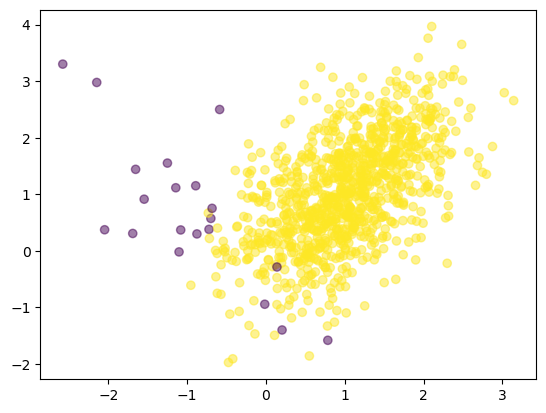
시각화
import matplotlib.pyplot as plt

plt.scatter(X[:, 0], X[:, 1], alpha=0.5, c=y)
선형 판별 분석
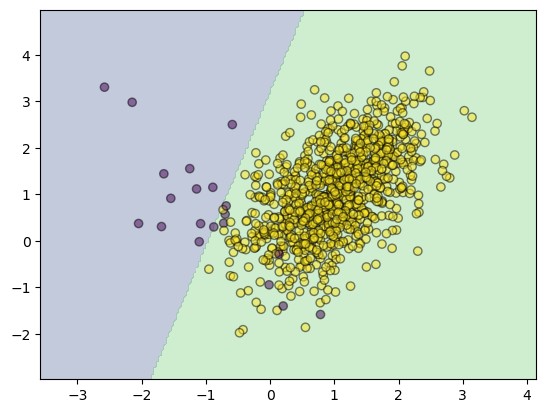
- 선형 판별 분석으로 분류
from sklearn.discriminant_analysis import LinearDiscriminantAnalysis

lda = LinearDiscriminantAnalysis()
lda.fit(X, y)

lda.score(X, y)
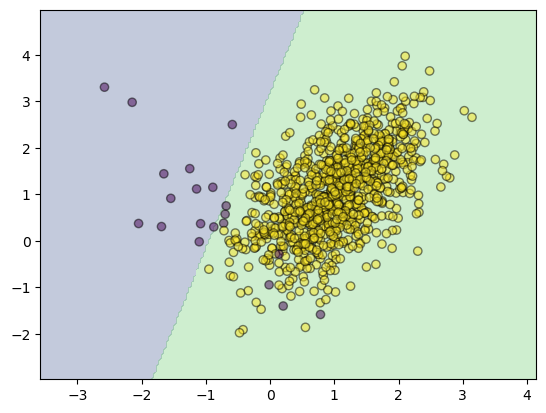
결과 시각화
x_min, x_max = X[:, 0].min() - 1, X[:, 0].max() + 1
y_min, y_max = X[:, 1].min() - 1, X[:, 1].max() + 1

xx, yy = np.meshgrid(
    np.linspace(x_min, x_max, 200),
    np.linspace(y_min, y_max, 200),
)

Z = lda.predict(np.c_[xx.ravel(), yy.ravel()])
Z = Z.reshape(xx.shape)

plt.scatter(X[:, 0], X[:, 1], alpha=0.5, c=y, edgecolor="k")
plt.contourf(
    xx,
    yy,
    Z,
    alpha=0.3,
    levels=np.linspace(Z.min(), Z.max(), 3),
    zorder=-1,
)
오버샘플링
- 오버샘플링(oversampling): 소수 클래스의 데이터를 복제하거나 합성해 늘림
- 소수 클래스의 분류 성능이 향상
- 정보가 손실되지 않음
- 과적합 위험
- 훈련 시간 증가
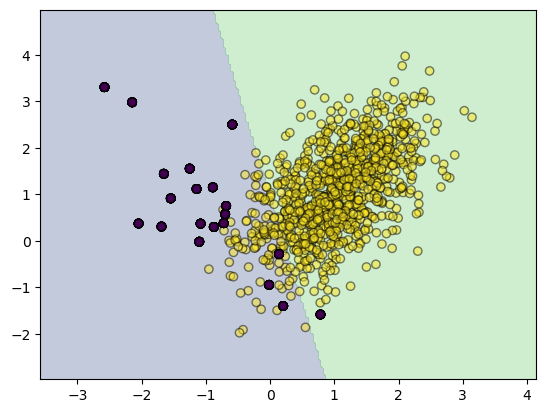
랜덤 오버샘플링
- 소수 클래스에서 무작위로 골라 복제
from imblearn.over_sampling import RandomOverSampler

sampler = RandomOverSampler(random_state=0)
X_resampled, y_resampled = sampler.fit_resample(X, y)

lda = LinearDiscriminantAnalysis()
lda.fit(X_resampled, y_resampled)
plt.scatter(
    X_resampled[:, 0],
    X_resampled[:, 1],
    alpha=0.5,
    c=y_resampled,
    edgecolor="k",
)
SMOTE
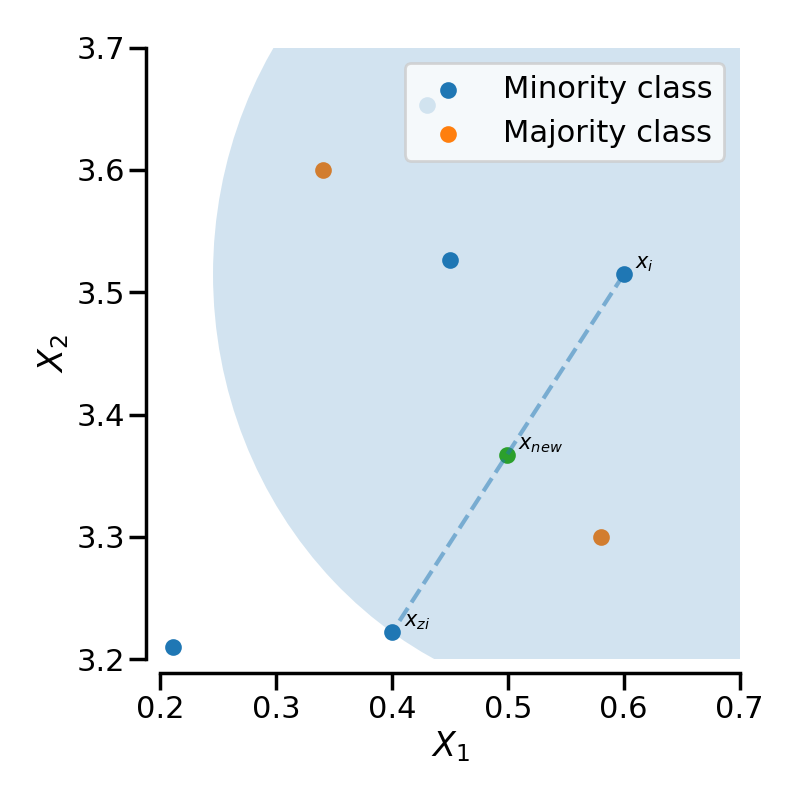
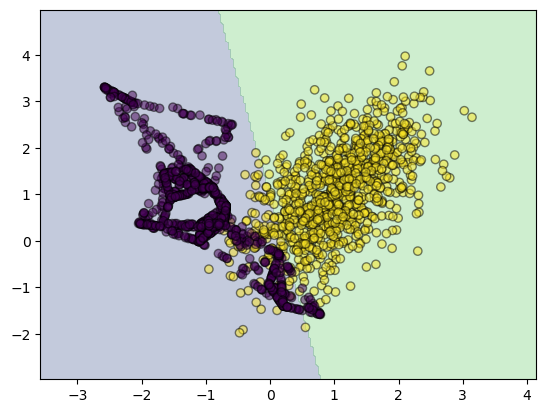
- SMOTE: Synthetic Minority Over-sampling Technique
- 랜덤 오버샘플링은 과적합 우려가 있음
- 가까운 두 사례에서 0에서 1 사이의 랜덤한 비율로 내분하는 새로운 점을 합성
SMOTE 실습
from imblearn.over_sampling import SMOTE

sampler = SMOTE(random_state=0)
X_resampled, y_resampled = sampler.fit_resample(X, y)
ADASYN
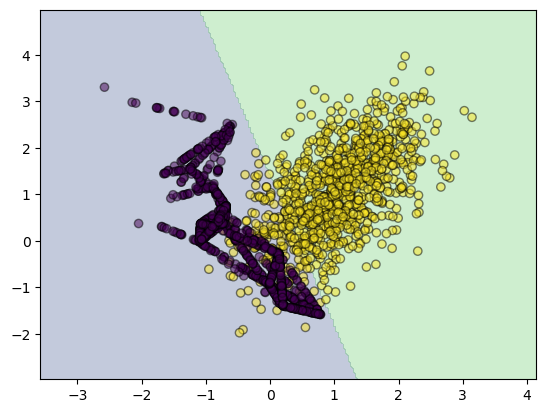
- ADASYN: Adaptive Synthetic
- SMOTE처럼 모든 데이터를 고르게 증가시키는 대신, 경계선 근방의 데이터를 더 많이 증가시킴
from imblearn.over_sampling import ADASYN

sampler = ADASYN(random_state=0)
X_resampled, y_resampled = sampler.fit_resample(X, y)
언더샘플링
- 언더샘플링(undersampling): 다수 클래스의 데이터를 삭제해 줄임
- 다수 클래스의 분류 성능이 하락할 수 있음
- 정보가 손실됨
- 과적합 위험이 낮음
- 훈련 시간 감소
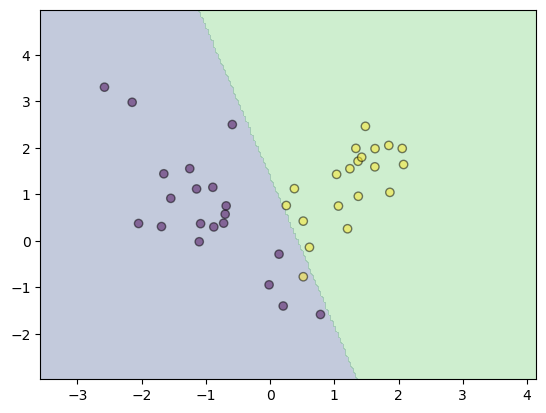
랜덤 언더샘플링
from imblearn.under_sampling import RandomUnderSampler

rus = RandomUnderSampler(random_state=0)
X_resampled, y_resampled = rus.fit_resample(X, y)
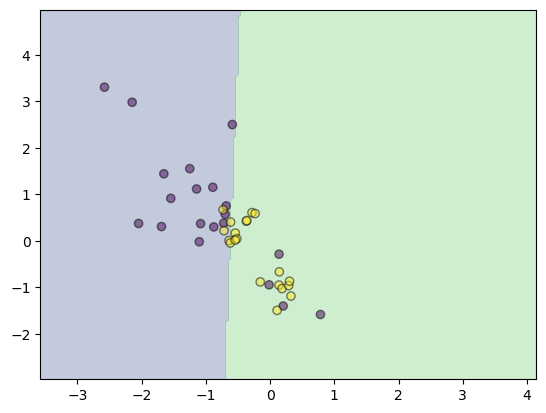
NearMiss
- 경계선 근처의 사례만 남김
from imblearn.under_sampling import NearMiss

sampler = NearMiss()
X_resampled, y_resampled = sampler.fit_resample(X, y)
Tomek Links
- 소수 클래스와 접한 다수 클래스를 삭제
from imblearn.under_sampling import TomekLinks

sampler = TomekLinks()
X_resampled, y_resampled = sampler.fit_resample(X, y)

실습 데이터: 상수도 배관 누수 조기 탐지
- 배관 운영 기록 1,500건
- 현재 센서와 정비 기록으로 24시간 이내 누수 발생 여부 예측
leak_next_24h는0=정상,1=누수 발생- 입력 변수는 모두 숫자형
| 컬럼 | 설명 |
|---|---|
pressure_drop_kpa |
압력 감소량(kPa) |
flow_imbalance_pct |
유입·유출 유량 차이(%) |
acoustic_level_db |
배관 음향 수준(dB) |
night_flow_lpm |
야간 분당 유량(L/min) |
soil_moisture_pct |
주변 토양 수분(%) |
pipe_age_years |
배관 사용 연수 |
recent_valve_operations |
최근 밸브 조작 횟수 |
temperature_change_c |
최근 온도 변화(°C) |
leak_next_24h |
24시간 이내 누수 여부(0=정상, 1=누수 발생) |
데이터 불러오기와 학습/평가 데이터 분할
import pandas as pd
from sklearn.model_selection import train_test_split
from sklearn.preprocessing import StandardScaler

df_pipe = pd.read_excel("pipeline_leak.xlsx")

X = df_pipe.drop(columns="leak_next_24h")
y = df_pipe["leak_next_24h"]

X_train, X_test, y_train, y_test = train_test_split(
    X,
    y,
    test_size=0.2,
    random_state=42,
    stratify=y,
)

scaler = StandardScaler()
X_train_scaled = scaler.fit_transform(X_train)
X_test_scaled = scaler.transform(X_test)
- 거리 기반 리샘플링을 위해 입력 변수의 척도를 맞춤
- 리샘플링은 학습 데이터에만 적용하고 테스트 데이터는 그대로 유지
- 아래 문항을 순서대로 해결하며 원본 모델과 리샘플링 결과 비교
퀴즈
불균형 데이터에 대한 설명으로 가장 적절한 것은?
퀴즈를 풀려면 대화형 기능을 불러와야 합니다.